
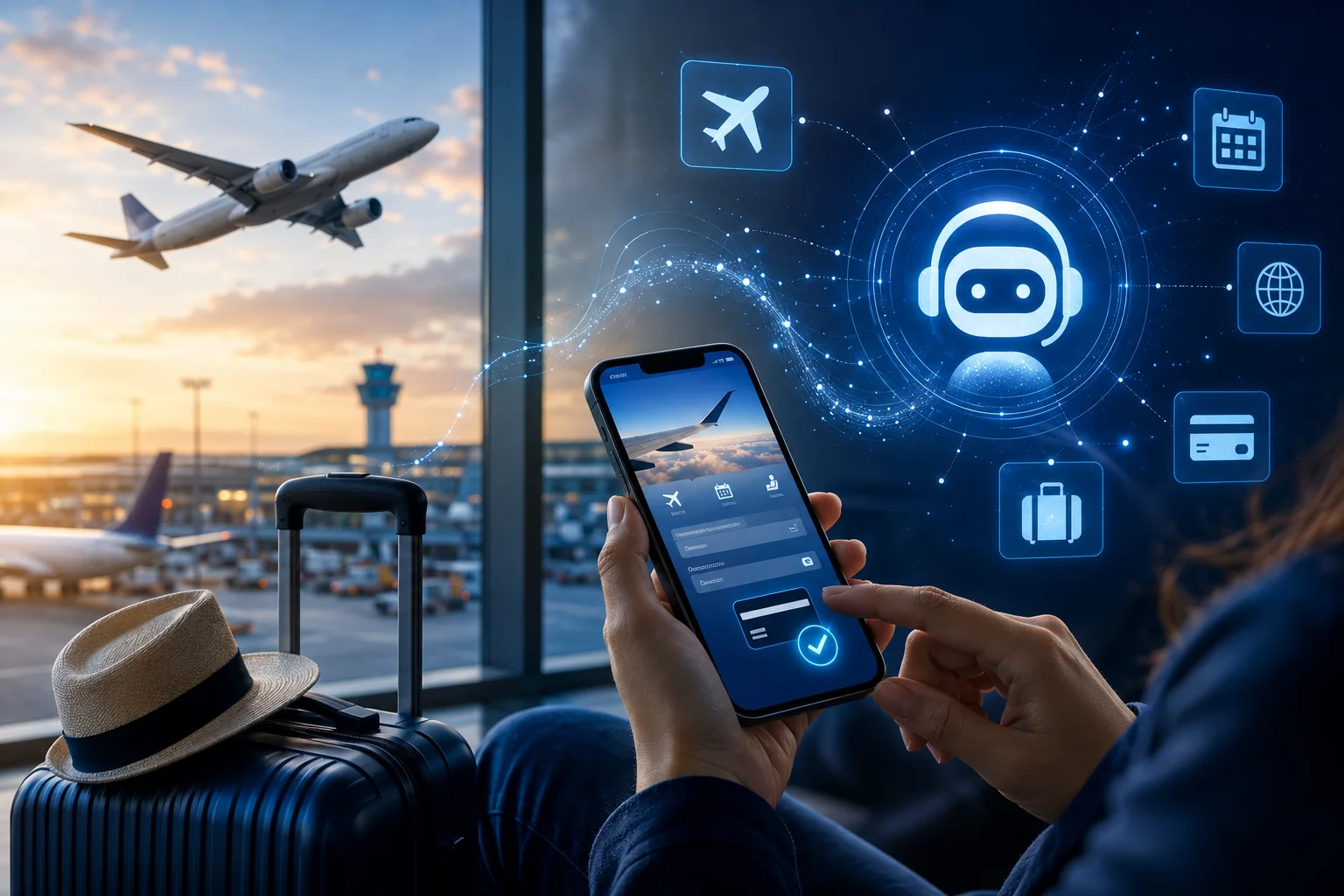
For decades, airline payments have remained largely invisible to passengers. A ticket is booked, a card is charged and the journey begins. Behind every transaction, however, sits one of the travel industry's most complex financial ecosystems, spanning multiple countries, currencies, payment providers, banks and regulators.
September 1, 2026 • Avionyz Editorial

Now, a new technology is beginning to reshape this landscape.
According to Thomas Helldorff, Vice President for Airlines and Travel at Worldpay, now part of Global Payments, agentic artificial intelligence could eventually transform how travellers search, book and pay for flights. While fully autonomous payments remain some way off, the industry is already using AI to strengthen fraud prevention, improve payment approvals and simplify customer experiences.
Airline payments are becoming a strategic business priority
Payments were once considered a back-office function for airlines.
According to Helldorff, this changed dramatically following the Covid-19 pandemic, when refunds, transaction management and customer payments became central to airline operations. Since then, payment systems have evolved into an important commercial lever for airlines seeking higher efficiency and stronger profitability.
A modern payment strategy now helps airlines:
- Reduce payment processing costs.
- Improve fraud protection.
- Increase transaction approval rates.
- Expand into new markets through local payment methods.
- Build customer loyalty through smoother checkout experiences.
According to Helldorff, even a small improvement in payment acceptance rates can make a meaningful contribution to an airline's financial performance.
From cards to digital wallets
The way travellers pay for flights has changed significantly over the past two decades.
Helldorff explained that airline payments were once dominated by a handful of international card networks. Today, payment options have expanded to include:
- Digital wallets.
- QR code payments.
- Account-to-account (A2A) payment solutions.
- Central bank digital currencies (CBDCs).
- Stablecoins.
He noted these payment methods are no longer niche alternatives. They have become an increasingly important part of the global payment mix as travellers expect faster, more flexible and more localised ways to pay.
What is agentic AI?
One of the most closely watched developments is agentic commerce.
Unlike today's online booking process, where customers manually search, compare and complete transactions, agentic AI introduces software agents capable of acting on a traveller's behalf.
Helldorff described this as the next stage in digital commerce, where consumers could eventually authorise trusted AI systems to search for flights, compare fares, make bookings and complete payments autonomously. Such models would require payment infrastructure, transaction messaging and industry rules to evolve alongside AI technology.
For now, however, fully autonomous payments remain largely theoretical.
According to Helldorff, AI currently plays a much bigger role during the search and planning stages of a journey than during the payment itself. Today's agentic payment models still require customer input and approval before transactions are completed.
AI is already improving airline payments
Although autonomous booking is still emerging, artificial intelligence is already delivering practical benefits across airline payment operations.
Helldorff said AI is helping payment providers:
- Detect fraudulent behaviour in real time.
- Reduce false payment declines.
- Improve transaction approval rates.
- Support regulatory compliance.
- Enhance operational reliability.
He added that Worldpay has used AI to optimise its authentication services, leading to higher payment approval rates for airline and cruise customers. AI is also being applied to compliance activities such as Know Your Customer (KYC) checks and Anti-Money Laundering (AML) monitoring by automating the identification of irregularities and producing audit-ready records across multiple jurisdictions.
Legacy systems remain a major challenge
While payment technology continues to advance rapidly, airline infrastructure has not always kept pace.
According to Helldorff, many of the industry's core payment standards were developed more than 50 years ago, long before digital wallets, AI or alternative payment methods became commonplace. Standards maintained by organisations including the International Air Transport Association (IATA) and the Airlines Reporting Corporation (ARC) continue to underpin the global travel ecosystem.
Updating these systems is particularly difficult because more than 70,000 airlines and travel distribution participants depend on them and would need to adopt changes in a coordinated manner.
Helldorff also highlighted the continued reliance on Mail Order/Telephone Order (MOTO) transactions in some airline ticket sales. According to him, these older payment methods can increase processing fees and may struggle to meet future regulatory requirements, including the proposed Payment Services Directive 3 (PSD3).
Innovation will depend on trust
The airline industry has a long history of payment innovation. Helldorff noted that the airline-owned Universal Air Travel Plan (UATP) became the world's first international card scheme and introduced the card numbering structure still reflected in many payment cards today.
Looking ahead, he believes collaboration between payment providers, airlines, technology companies, banks and card networks will determine how quickly agentic commerce becomes reality. Worldpay has established a dedicated team focused on developing protocols and trust standards for AI-driven commerce and is engaging with industry stakeholders to prepare for future travel applications.
According to IATA, global passenger ticket revenues are expected to reach US$751 billion in 2026, highlighting the growing importance of secure, efficient and scalable payment systems for airlines worldwide. As AI capabilities mature and digital payment options continue to expand, the way travellers search, book and pay for flights is likely to evolve significantly. While fully autonomous travel payments remain in their early stages, the industry's direction is becoming increasingly clear: intelligent, personalised and seamless payment experiences are set to play a larger role in the future of aviation.
Join the conversation
No comments yet
Be the first to share your thoughts!
Sign In to Comment