

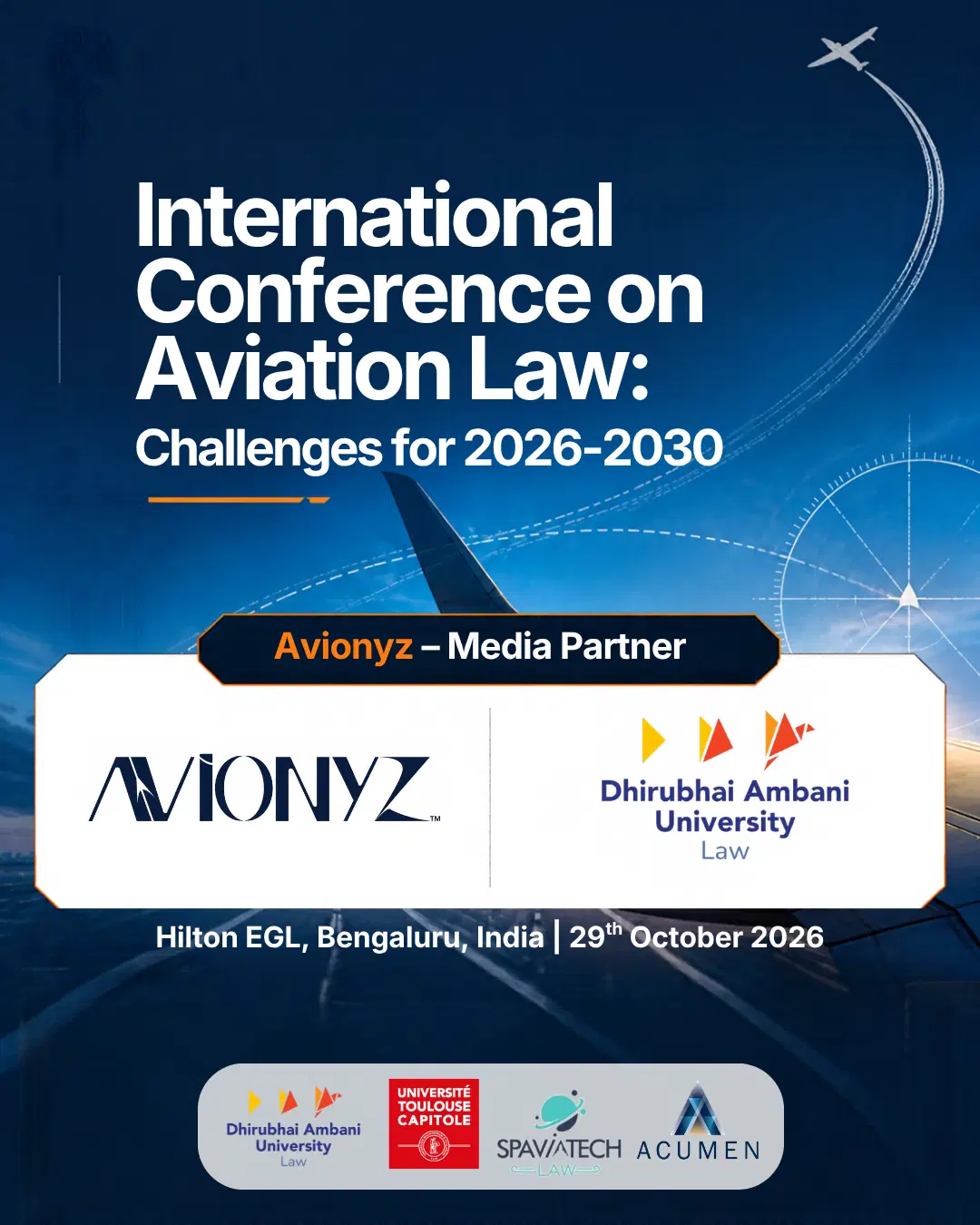
The International Conference on Aviation Law: Challenges for 2026–2030 will take place on 29 October 2026 at Hilton Embassy Golf Links, Bengaluru. Organised by the School of Law, Dhirubhai Ambani University, in collaboration with Université Toulouse Capitole, Spaviatech Law and Acumen Aviation, the conference will examine the legal and regulatory questions confronting the aviation sector as it enters a period of technological, commercial and geopolitical change.
October 28, 2026 • Avionyz Editorial

Aviation is shaped by more than aircraft, airports and airline operations. Behind every international flight, aircraft financing agreement, technology deployment and cross-border transaction lies a complex framework of laws, regulations and contractual obligations. As the industry evolves, these frameworks must respond to emerging risks while supporting safety, innovation and international commerce.
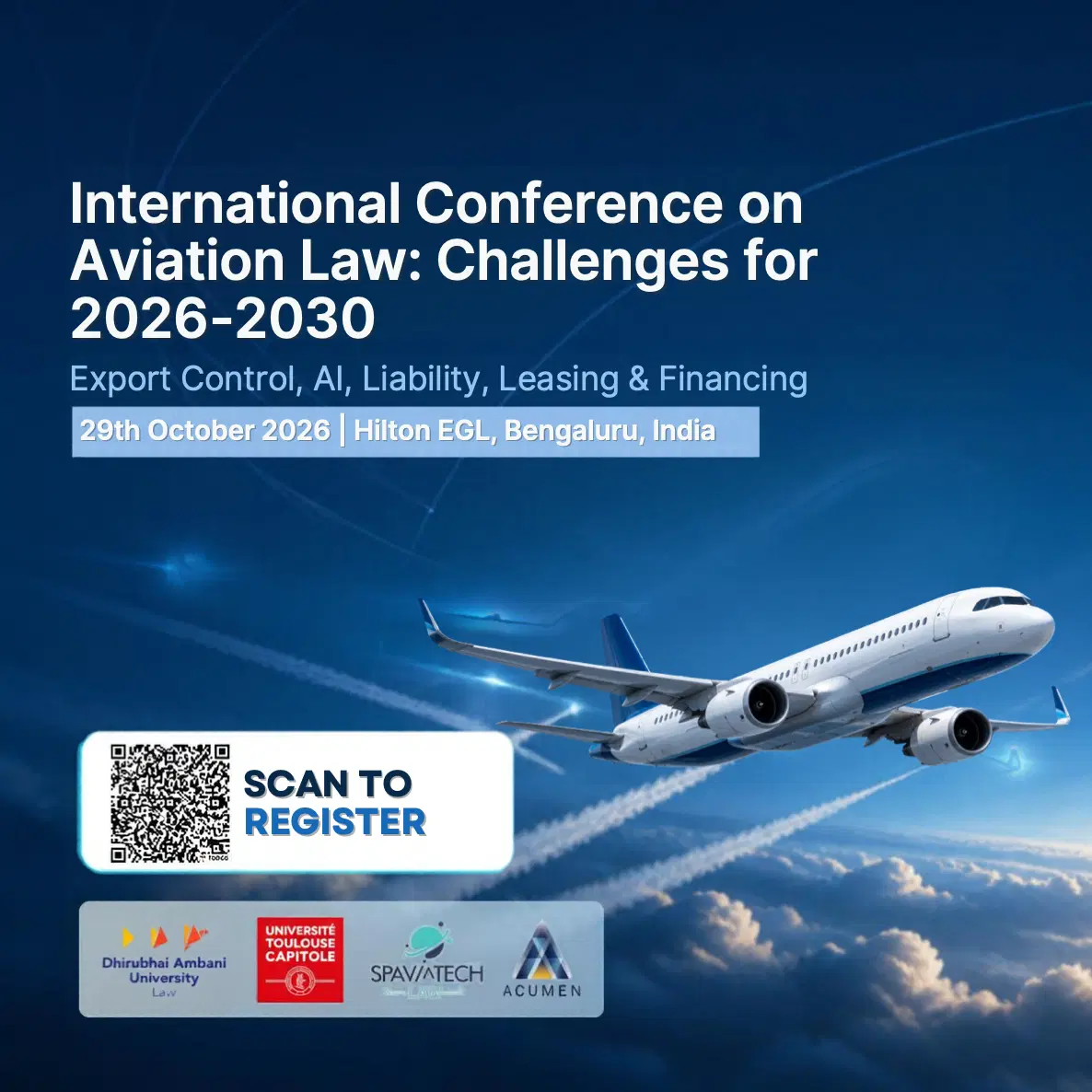
The period between 2026 and 2030 is expected to bring important questions for aviation stakeholders. Advances in artificial intelligence, changing geopolitical conditions, complex international trade requirements and the continuing importance of aircraft leasing and financing are increasing the need for informed legal and regulatory decision-making.
Against this backdrop, the upcoming International Conference on Aviation Law: Challenges for 2026–2030 will bring focused attention to five areas of aviation law: export and trade controls, sanctions, artificial intelligence and emerging technologies, aviation liability, and aircraft leasing and financing
Speakers at the Conference
The conference will feature speakers from academia and the aviation industry, bringing perspectives on aviation law, regulatory compliance, technology and commercial practice.
Prof. (Dr.) Laurent Grosclaude — Director of LL.M. International Aviation Law at Université Toulouse Capitole, France
Alok Anand — Chairman & CEO, Acumen Aviation
Rakhee Biswas — Co-Managing Partner, Spaviatech Law
Malik Almajdalawi — Programs Quality & Compliance Manager at Pilatus Aircraft, Switzerland, and Honorary Professor of International Aviation Law
Syed Tamjeed Ahmad — Co-Managing Partner, Spaviatech Law
Dr. Ivneet Kaur Walia — Officiating Registrar and Associate Professor of Law at Rajiv Gandhi National University of Law, Punjab
Prof. (Dr.) Vini Singh — Associate Professor & Head, AI, Data Protection and Technology Law Vertical at Dhirubhai Ambani University – School of Law
Prof. Sivadath Madhu Menon — Assistant Professor and Head, Aviation Law and Management Vertical at Dhirubhai Ambani University – School of Law
Export and Trade Controls: Navigating Cross-Border Requirements
Aviation operates through international supply chains. Aircraft manufacturers, component suppliers, maintenance providers, airlines and technology companies may work across multiple jurisdictions, each with its own legal requirements.
Export-control rules can affect the movement of aircraft components, technical information, software and other controlled items. Businesses involved in international aviation transactions must understand which requirements apply to their activities and how compliance obligations affect commercial decisions.
The challenge extends beyond identifying the rules. Companies must also consider how their supply chains, contractual arrangements and internal compliance processes respond to changing regulatory requirements.
The conference will examine the intersection of export and trade controls with aviation operations and transactions, an issue of particular importance to businesses operating across borders.
Sanctions: The Legal Implications of a Changing Geopolitical Environment
Economic sanctions have become an important consideration for international businesses, including those operating in aviation. Restrictions imposed by governments can affect commercial relationships, aircraft transactions, financing arrangements, leasing structures, maintenance support and the supply of components.
For aviation companies, sanctions compliance can involve multiple jurisdictions and parties. A transaction that appears commercially straightforward may require careful examination of counterparties, ownership structures, payment arrangements and the services involved.
The consequences of non-compliance can extend beyond legal penalties to contractual disputes, operational disruption and reputational damage. Businesses therefore need appropriate processes for identifying and managing sanctions-related risks.
By addressing sanctions as a dedicated theme, the conference will consider the practical and legal challenges aviation stakeholders face in an increasingly complex geopolitical environment.
Artificial Intelligence and Emerging Technologies: Keeping Legal Frameworks in Step
Artificial intelligence and other emerging technologies are creating new possibilities across aviation. Applications may influence maintenance planning, operational decision-making, customer services, data analysis and other areas of the industry.
However, technological capability also raises questions about responsibility, oversight and accountability. If an AI-enabled system contributes to an operational error or a commercial loss, determining responsibility may require careful consideration of the technology, the people using it, contractual arrangements and applicable legal frameworks.
Questions surrounding data, system reliability, human oversight and the allocation of liability will remain important as aviation organisations explore new technologies.
The central issue is how legal and regulatory frameworks can accommodate technological development without compromising safety, accountability or public confidence. The conference will examine whether existing aviation law is sufficiently equipped to address AI driven transformation.
Aviation Liability: Addressing New Risks and Responsibilities
Liability has long been central to aviation law, covering questions that arise when accidents, operational failures, contractual disputes or other losses occur.
As technology, operating models and commercial relationships change, determining responsibility can become more complex. Multiple organisations may contribute to a single operation, including airlines, manufacturers, maintenance providers, technology suppliers and other service partners.
Understanding how liability is allocated requires attention to applicable laws, contractual terms, insurance arrangements and the specific circumstances of each case.
For aviation businesses, clear contractual responsibilities and effective risk-management processes can be important in reducing uncertainty when disputes arise. Legal frameworks must also continue to address how established principles apply to changing technologies and industry practices.
The conference's aviation-liability session will consider how traditional frameworks are responding to these developments.
Aircraft Leasing and Financing: The Legal Foundations of Aviation Growth
Aircraft leasing and financing play a central role in the commercial structure of modern aviation. Airlines use a range of financing and leasing arrangements to obtain aircraft, manage capital requirements and support fleet strategies.
These transactions can involve several parties across different jurisdictions, including airlines, lessors, lenders, manufacturers and insurers. Their legal structures must address matters such as contractual obligations, asset ownership, security interests, payment defaults and the rights of parties if a transaction encounters difficulties.
Cross-border transactions can introduce further complexity, particularly where the laws governing a contract, the location of an asset and the jurisdictions involved do not align neatly.
As airlines and aviation businesses pursue growth, a clear understanding of the legal frameworks underpinning aircraft financing and leasing remains essential. The conference will explore this area as one of the key issues facing aviation between 2026 and 2030.
Why Focused Discussion Matters
The legal questions facing aviation rarely exist in isolation. A single commercial decision may involve technology, trade restrictions, financing, contractual risk and regulatory compliance simultaneously.
Addressing these issues requires dialogue between legal practitioners, academics and industry professionals who understand how regulatory principles interact with operational and commercial realities.
The conference will follow an expert-led conversation, with one expert speaker addressing each subject, followed by opportunities for interaction and discussion. According to the official programme, this approach is intended to allow deeper engagement with individual topics and more focused exchanges between speakers and participants.
The event is organised by the School of Law, Dhirubhai Ambani University, in collaboration with Université Toulouse Capitole, Spaviatech Law and Acumen Aviation. Its focus reflects the increasingly international character of aviation law, where regulatory decisions and commercial arrangements can have consequences across multiple markets
Preparing for Aviation’s Next Phase
As the aviation industry looks towards 2030, its ability to innovate and expand will depend not only on technological progress and commercial investment, but also on how effectively legal and regulatory challenges are understood and managed.
Export controls, sanctions, artificial intelligence, liability, and aircraft financing each raise distinct questions. Together, they illustrate the breadth of legal considerations that underpin a globally connected industry.
The International Conference on Aviation Law: Challenges for 2026–2030 will provide a dedicated forum to examine these issues and consider how industry stakeholders, regulators and legal professionals can prepare for the years ahead.
Conference: International Conference on Aviation Law: Challenges for 2026–2030
Date: 29th October, 2026
Venue: Hilton Embassy Golf Links, Bengaluru
Organisers: School of Law, Dhirubhai Ambani University; Université Toulouse Capitole; Spaviatech Law; and Acumen Aviation
Conference Website: https://sol.dau.ac.in/programmes/international-conference-on-aviation-law-challenges-for-2026-2030-484708
Stay tuned to Avionyz for agenda updates, exclusive interviews and complete coverage before and throughout the International Conference on Aviation Law: Challenges for 2026 2030

Join the conversation
No comments yet
Be the first to share your thoughts!
Sign In to Comment